


Types of AC in Dubai: 9 Air Conditioner Systems Explained
23 October 2026 | by admin
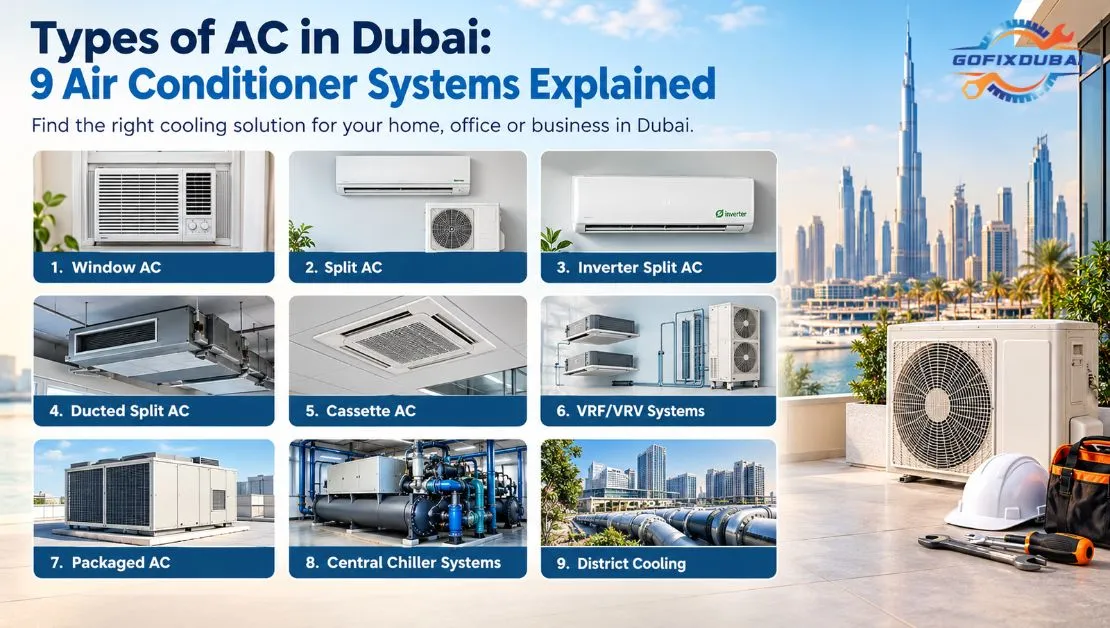
Air conditioning is essential for maintaining comfortable indoor temperatures in Dubai’s hot climate. However, not every property uses the same cooling system. From wall-mounted split air conditioners in apartments to ducted systems in villas and central cooling in commercial buildings, different types of AC are designed for different spaces and cooling requirements.
The main types of AC include window AC, split AC, inverter split AC, ducted split AC, cassette AC, VRF/VRV systems, packaged AC, central chiller systems and district cooling. Understanding how these systems work can help homeowners, tenants and business owners choose appropriate equipment, identify maintenance requirements and improve cooling efficiency.
This guide explains the different types of air conditioners, their advantages, common applications and what to consider when maintaining an AC system in Dubai.
What Are the Different Types of AC?
Air conditioners can be classified according to their installation, cooling technology and the way they distribute conditioned air. Some systems cool individual rooms, while others serve several rooms or entire buildings.
The most common types include:
- Window air conditioners for individual rooms.
- Split and inverter split ACs for apartments, villas and offices.
- Ducted split ACs for cooling multiple rooms through concealed ducts.
- Cassette ACs for suspended ceilings and commercial interiors.
- VRF/VRV systems for buildings requiring independently controlled cooling zones.
- Packaged AC units for selected commercial and larger spaces.
- Central chiller systems for large buildings.
- District cooling systems that supply chilled water to connected properties.
According to Dubai Electricity and Water Authority (DEWA), cooling technologies include direct expansion (DX) systems, chillers and district cooling. These systems differ in how they produce and distribute cooling.
-
Window Air Conditioner
A window AC is a self-contained cooling unit installed in a suitable window or wall opening. Its main components are housed in one unit, allowing it to cool an individual room without an extensive duct network.
Advantages of window AC
- Relatively straightforward installation where a suitable opening exists.
- Can be suitable for cooling a small, enclosed room.
- Does not require a separate indoor and outdoor unit.
- Individual room temperature control.
Limitations
Window ACs can produce more indoor noise than some split systems and may obstruct part of a window. They also require a suitable opening and proper sealing to prevent warm air from entering.
Where is it suitable?
A window air conditioner may suit a small room or a property with an existing window AC installation. However, installation restrictions, building rules, noise and energy efficiency should be considered before choosing one in Dubai.
-
Split Air Conditioner
A split AC consists of an indoor unit and an outdoor unit connected by refrigerant piping and electrical connections. The indoor unit circulates cooled air, while the outdoor unit releases heat from the indoor space.
Wall-mounted split ACs are widely recognised in residential and small commercial settings because they provide dedicated cooling for individual rooms.
Advantages of split AC
- Quiet indoor operation compared with many window units.
- Independent temperature control for the room served by the unit.
- Flexible installation options when the property permits them.
- Available in different capacities to suit different room sizes.
Limitations
A split AC requires an appropriate location for the outdoor unit, professional installation and regular maintenance. A unit that is too small for the room may struggle to cool it effectively, while an oversized unit may cycle inefficiently in some operating conditions.
Where is it suitable?
Split ACs are suitable for many bedrooms, living rooms, small offices and other spaces needing individual cooling.
-
Inverter Split AC
An inverter AC is not a completely separate installation category. It uses inverter technology to adjust compressor speed according to cooling demand rather than relying only on repeated full-speed operation and shutdown.
This can help maintain more consistent temperatures and reduce electricity consumption under suitable operating conditions.
Advantages of inverter AC
- More consistent temperature control.
- Potentially lower energy consumption than a comparable non-inverter model.
- Reduced compressor start-stop cycling during normal operation.
- Can be suitable for rooms that require extended periods of cooling.
Limitations
Actual energy savings depend on the model’s efficiency rating, correct sizing, installation quality, thermostat settings, room insulation and usage patterns. An inverter model will not compensate for dirty filters, refrigerant problems or an incorrectly sized system.
Where is it suitable?
An inverter split AC may be a practical choice for Dubai homes and offices where air conditioning operates for long periods. Compare the energy-efficiency ratings and capacity of individual models before purchasing.
-
Ducted Split AC
A ducted split AC uses an indoor air-handling unit, usually concealed above a ceiling or in another service space, to distribute cooled air through ducts and ceiling grilles.
Instead of placing a wall-mounted unit in every room, a ducted installation can serve several rooms through a designed duct network.
Advantages of ducted AC
- Concealed equipment creates a clean interior appearance.
- Can cool multiple connected rooms.
- Can provide a consistent overall cooling arrangement when properly designed.
- Suitable for many larger homes, villas and commercial interiors.
Limitations
Installation is more complex than installing a standard wall-mounted split AC. The system needs sufficient space for ducts and equipment, and its performance depends on duct design, insulation, airflow balancing and maintenance access.
Dust accumulation, restricted airflow or leaking ducts can reduce performance and cause uneven cooling between rooms.
Where is it suitable?
Ducted AC can work well in villas, larger apartments designed for ductwork and commercial spaces requiring concealed air distribution.
-
Cassette Air Conditioner
A cassette AC is generally installed in a suspended ceiling, with the visible panel positioned at ceiling level. Many models distribute air in multiple directions to help cool an open area more evenly.
Cassette systems commonly use split-system refrigeration technology, although the exact configuration depends on the model and installation.
Advantages of cassette AC
- Saves wall space.
- Offers a neat, ceiling-mounted appearance.
- Can distribute air across a relatively open space.
- Available in configurations suited to offices, shops and meeting rooms.
Limitations
A cassette AC requires suitable ceiling space, drainage, piping and access for maintenance. Installation may be difficult where the ceiling structure cannot accommodate the unit.
Its cooling performance also depends on the unit’s capacity, layout and the placement of furniture and partitions.
Where is it suitable?
Cassette ACs are useful for offices, retail outlets, restaurants and other commercial interiors with suitable ceilings.
-
VRF/VRV Air Conditioning System
Variable Refrigerant Flow (VRF) and Variable Refrigerant Volume (VRV) systems use refrigerant-based technology to serve multiple indoor units from a coordinated outdoor system. VRV is a trademark used by Daikin, while VRF is the broader industry term.
Depending on the system design, different indoor units or zones can have individual temperature controls.
Advantages of VRF/VRV
- Supports multiple cooling zones.
- Offers flexible control for different rooms and occupancy patterns.
- Can provide efficient part-load operation when correctly designed.
- Suitable for larger villas, offices and commercial buildings.
Limitations
VRF/VRV installations require detailed system design, compatible equipment, appropriate refrigerant piping and specialist maintenance. Installation and repair can be more complex than servicing a single split AC.
Where is it suitable?
VRF/VRV can be appropriate for larger properties where several rooms require separate controls, particularly when cooling needs vary throughout the building.
-
Packaged Air Conditioner
A packaged AC combines major refrigeration and air-conditioning components within a common cabinet. Depending on its design, it can supply cooled air directly or distribute it through ductwork.
Packaged units are generally selected for particular commercial and larger-space applications rather than as a default replacement for every residential split AC.
Advantages of packaged AC
- Combines major components in a consolidated unit.
- Can deliver substantial cooling capacity.
- Can be integrated with ductwork for larger spaces.
- May simplify equipment arrangement in suitable buildings.
Limitations
Packaged systems require appropriate equipment placement, ventilation, service access and correctly designed air distribution. Performance also depends on capacity selection and regular maintenance.
Where is it suitable?
Packaged ACs may be used in shops, commercial premises, selected villas and other applications where the system design supports this configuration.
-
Central Chiller Air Conditioning System
A central chiller system cools water using refrigeration equipment. The chilled water is then circulated to air-handling units or fan coil units, which transfer cooling to indoor spaces.
Unlike a conventional split AC that cools air directly through its refrigerant-based indoor unit, a chiller-based system distributes cooling through chilled water.
Advantages of central chiller systems
- Suitable for large buildings with substantial cooling demand.
- Can serve multiple areas through a central cooling plant.
- Supports centralised equipment management.
- Can be integrated with building management and zone-control systems.
Limitations
Central systems involve more complex equipment, pumps, piping and control arrangements. Their efficiency and reliability depend on appropriate plant operation, water circulation, heat exchange and maintenance.
Where is it suitable?
Chiller-based cooling is commonly associated with larger buildings, such as hotels, commercial properties and large residential developments. The precise configuration depends on the building’s design.
-
District Cooling System
District cooling is different from installing an independent AC unit or operating a private chiller plant. A district cooling provider produces chilled water centrally and distributes it through an insulated pipe network to connected buildings.
Inside the property, a heat exchanger and associated equipment transfer that cooling to the building’s own air-conditioning circuit. The indoor cooling equipment may include fan coil units or air-handling units.
Advantages of district cooling
- Cooling production is centralised rather than duplicated in every connected property.
- Large cooling plants can serve multiple buildings.
- Building-level equipment can be integrated into local controls.
- Residents may not need to manage a separate outdoor AC condenser for the cooling supplied by the district system.
Limitations
Residents and property managers depend on the connected building’s cooling arrangement and the district cooling provider. Charges, billing methods, service responsibilities and maintenance arrangements vary.
A resident may still need to maintain internal equipment, clean filters, monitor condensate drainage and report faults according to the building’s procedures.
Where is it suitable?
District cooling is used in developments connected to a district cooling network. Before troubleshooting an AC problem in a Dubai apartment, check whether the property uses district cooling, a central chiller or an independent split system.
Comparison of Different Types of AC
| AC type | Typical application | Main advantage | Important consideration |
| Window AC | Small individual rooms | Self-contained unit | Window or wall opening required |
| Split AC | Bedrooms, living rooms and small offices | Independent room cooling | Outdoor unit and installation space |
| Inverter split AC | Homes and offices with extended cooling use | Variable compressor operation | Savings depend on efficiency and usage |
| Ducted split AC | Villas and multi-room spaces | Concealed air distribution | Duct design and maintenance access |
| Cassette AC | Offices, shops and open interiors | Ceiling-mounted installation | Suitable ceiling space required |
| VRF/VRV | Larger villas and commercial buildings | Multiple controlled zones | Specialist design and servicing |
| Packaged AC | Selected commercial spaces | Consolidated equipment | Correct placement and airflow design |
| Central chiller | Large buildings | Centralised cooling plant | Pumps, water circuits and central equipment |
| District cooling | Connected residential and commercial developments | Shared cooling production | Provider and building arrangements |
Which Type of AC Is Best for Dubai Homes and Offices?
There is no single best type of AC for every property in Dubai. The right option depends on the building’s existing cooling infrastructure, room size, layout, cooling demand and permitted installation changes.
Consider these factors before making a decision:
- Property type: A wall-mounted split unit may suit an individual room, while a villa with concealed ductwork may be better served by a ducted system. An apartment may already be connected to district cooling or a central chiller.
- Cooling capacity: Select equipment based on the room’s cooling load, including its size, sun exposure, windows, insulation and occupancy. Room area alone is not enough to determine the correct capacity.
- Energy efficiency: Compare efficiency labels and manufacturer specifications. Inverter technology can help reduce energy use under suitable conditions, but correct sizing and installation remain important.
- Temperature control: Independent split units can provide room-level control. Ducted and central systems may have separate zones, depending on their design.
- Installation restrictions: Apartments and managed developments may have restrictions on changing outdoor units, refrigerant lines, ceilings or central cooling connections. Confirm building requirements before arranging an installation or replacement.
- Maintenance access: Filters, coils, condensate drains, electrical connections and outdoor equipment need appropriate inspection and servicing. Choose a system that can be maintained properly throughout its operating life.
AC Maintenance Tips for Dubai’s Climate
High cooling demand makes routine air-conditioner maintenance important. Dust, restricted airflow, drainage problems and neglected equipment can reduce performance and contribute to unexpected breakdowns.
Follow these practical maintenance tips:
- Clean filters regularly: Check the manufacturer’s instructions and clean reusable filters at suitable intervals. DEWA recommends periodic filter cleaning, or at least once a month during summer.
- Keep the outdoor unit clear: Where an outdoor unit is installed, keep its airflow unobstructed and arrange professional coil cleaning when required.
- Check drainage: Watch for water dripping from indoor units, damp ceiling areas or moisture around AC equipment.
- Monitor cooling performance: Reduced airflow, uneven temperatures and unusual noises can indicate a maintenance issue.
- Use sensible thermostat settings: DEWA recommends setting the thermostat to 24°C or higher as an energy-saving practice, where that setting is comfortable.
- Arrange professional inspections: Have a qualified technician assess electrical components, refrigerant performance, coils, controls and other parts according to the equipment and its usage.
For official guidance, refer to DEWA’s cooling and energy-saving recommendations.
When Should You Call an AC Repair Technician?
Different types of AC can develop similar symptoms, but the cause may vary according to the system.
Arrange a professional inspection if you notice:
- The AC is running but not cooling properly.
- Airflow is weak or inconsistent.
- The unit makes unusual noises or develops a persistent smell.
- Ice forms on coils or refrigerant pipes.
- Water leaks from an indoor unit or ceiling.
- The system repeatedly switches on and off.
- Electricity consumption increases without an obvious explanation.
Avoid opening electrical compartments or attempting refrigerant repairs yourself. A technician can inspect the equipment and identify whether the issue involves filters, drainage, refrigerant performance, airflow, electrical components or the building’s central cooling system.
For a cooling problem at home or work, contact AC Repair Dubai Near Me to learn about GoFix Dubai’s AC repair and maintenance services.
If you are also dealing with a separate leaking water pipe, blocked sink or another plumbing issue, a Plumbing Company Dubai can help address the plumbing problem.
Frequently Asked Questions About Types of AC
-
What are the main types of AC?
The main types include window AC, split AC, inverter split AC, ducted split AC, cassette AC, VRF/VRV systems, packaged AC, central chiller systems and district cooling. Each has different installation requirements and suitable applications.
-
Which type of AC is suitable for an apartment in Dubai?
A split AC or inverter split AC may suit an apartment with independent cooling. Other apartments use ducted systems, fan coil units connected to a central chiller or district cooling. Check the building’s existing system before choosing a replacement.
-
Is inverter AC better than a normal split AC?
An inverter split AC adjusts compressor speed according to cooling demand and can provide more consistent temperatures with lower energy consumption under suitable conditions. Actual results depend on the model, efficiency rating, installation, sizing and usage.
-
What is the difference between central AC and district cooling?
A central AC system is a broad term for a building-level cooling arrangement, often using a central chiller and chilled-water distribution. District cooling supplies chilled water from a shared cooling plant through a network to connected buildings. The equipment and service responsibilities differ.
-
How often should AC filters be cleaned in Dubai?
Filter cleaning frequency depends on the equipment, dust levels and usage. DEWA recommends cleaning filters periodically, or at least monthly during summer. Follow the manufacturer’s instructions and seek professional cleaning when the coils, drainage or internal components require attention.
-
Why is my AC leaking water?
Common causes include a blocked condensate drain, dirty components, drainage problems or installation issues. In buildings using central or district cooling, the precise cause may relate to the internal fan coil or condensate system. A qualified technician should inspect persistent leaks to prevent water damage.
-
Can different types of AC be serviced by the same technician?
Technicians with suitable training can service various AC systems, but central chillers, district cooling equipment and VRF/VRV installations may require specialised expertise. Confirm that the technician is qualified for the system installed in your property.
Conclusion
Understanding the different types of AC helps Dubai residents and business owners make better decisions about cooling, energy efficiency and maintenance. Split and inverter ACs can suit individual rooms, ducted and cassette units provide different air-distribution options, and VRF/VRV, chiller and district cooling systems serve more complex requirements.
The best system is one that matches your property’s cooling needs, existing infrastructure and operating requirements. Regular filter cleaning, correct thermostat settings and timely professional maintenance can also help keep your air conditioner operating reliably.
If your AC is making unusual noises, leaking water or struggling to cool your property, arrange a professional inspection before the problem becomes more serious.
Recent Posts



Next Post
No next post